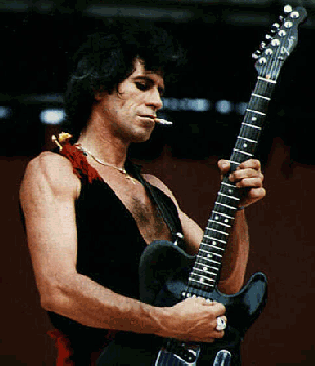
On Thursday, I attended the first of two introductory pool sessions run by Mark Harris at London Freedivers, who I'd met before and really liked. I learnt a lot about freediving. I also learnt that I am the first person Mark and his wife Laura have met who does not know who Keith Richards is. Yes, really. It looks like I need a musical as well as a freediving education! Coincidentally, Laura wrote a paper on HBOT for Multiple Sclerosis, so I'm going to ask her to let me read it before my visit to the London Diving Chamber next week.
I was joined by another beginner, Marcin, for the course. Marcin is a keen snorkeller who would like to lengthen the time he is able to explore the underwater world. My aim is quite different, but Mark explained how the content of the course was relevant to us both. We started off with an overview of the different disciplines and the equipment required. The pool course is limited to the static and dynamic disciplines, which were discussed in greater detail. Mark then demonstrated the correct way in which to "breathe-up" for apnea. I was pleased to see that I was breathing correctly, from the diaphragm through slightly pursed lips, to increase the pressure differential and encourage gas exchange in the lungs.
However, I also discovered that I had almost certainly been overbreathing when practicing dry statics. I had suspected that this might be the case, since my contractions (spasms of the diaphragm triggered by high levels of carbon dioxide) did not start until 2'50. I'd been advised by an experienced freediver I'd contacted online that this was too late for a beginner and that I must be overbreathing without being aware of it. He was right.
I had imagined that overbreathing or hyperventilation meant very quick, shallow, forced breaths. I felt that I'd been careful to take deep, slow breaths, even if I did notice myself speeding up slightly before the "final" breath. However, Mark advised a ratio of 6-7 breaths per minute to avoid hyperventilation; this was noticeably slower than how I had been practicing.
Hyperventilation is a bit of a dirty word amongst freedivers, and for good reason. Once an accpeted technique of extending breath holds, it is now considered to be a dangerous method of purging carbon dioxide from the system to the extent that the body's triggers for blackout are delayed. Rather than trying to purge as much carbon dioxide from the body as possible, freedivers now train to withstand higher levels of carbon dioxide and lower levels of oxygen.
Mark then explained the two main emergency situations that may occur during pool training (and indeed any other kind of freediving), Loss of Motor Control (LMC) and Blackout (BO). Without being alarmist, Mark explained to us the causes, signs and symptoms of a LMC and BO, and the emergency procedures used to address both situations. We were also instructed in how to avoid LMC and BO, as far as possible. The cardinal rule of freediving was hammered home (in a good way) - never freedive alone.
We then headed to the pool to put the theory into practice! Slightly intimidated by the lithe bodies stretching and doing complicated breathing excercises near the edge of the pool, I scampered over to Mark. Amazed that I had managed to get my old wetsuit on, I realised as soon as I hit the water that I definitely needed it - it was freezing! After a short discussion about safety tapping (where you're periodically tapped on the hand and respond by lifting a finger to confirm you're OK) it was time for my first "wet" static.
Using Mark's 6 breaths per minute ratio I spent two minutes in preparation. Then I slowly lowered myself into the water, floating with arms and legs relaxed. I'd aimed for what I thought was a fairly conservative 2'30 but came up at 2 minutes. Honestly, I was disappointed. I was cold, so my muscles were tense, and my mind was alert; I got nowhere near the "sleepy" trance-like state I can sometimes find doing dry statics in my bed. Noticing I wasn't particularly pleased, Mark gave me some kind words of encouragement and explained that several factors probably contributed to the dip in performance: the underlying stress of an instruction situation, the cold and it being my first "wet" static. He also explained that static times tend to get better after two or three repetitions and asked us to try three breath-holds with short intervals at home.
Marcin then started his first static. I concentrated on tapping at the correct intervals, and using light touches to adjust his position in the water when he started to drift toward the wall of the pool. Careful to make sure he returned my OK signal once he came up, I completely forgot to stop my stopwatch! Mark valiantly tried to suppress a good-natured chuckle and gave us both some pointers for improvement. It's important that I'm able to buddy properly since I'll be training with London Freediving for the next six months at least and I'm keen not to piss anyone off!
On my second try, with a 1 minute breathe-up I got to 2'42. Using the correct breathing ratio in preparation, I started to experience contractions at about 2'20. I'd not really experienced them before so I observed about 5, trying to relax after each one. Lastly, we practiced several rescue techniques for LMC and BO, which we'll build upon next week in deeper water.
As I left the pool I noticed a girl gliding effortlessly underwater, with fluid, undulating movements. I was mesmerised. She and I were like different species. At once, I felt a stab of fear as I realised for the first time how far I have to go.
It's not called a challenge for nothing!
Thanks to Mark, in less than two hours I learnt a huge amount. I was allowed to ask as many questions as I liked (there were a lot!) and was given detailed, precise answers. Despite his considerable experience, there was no judgment of the questions we asked and I didn't feel apprehensive about showing my lack of knowledge. The balance between theory and practice was just right. The atmosphere was informal, but we were certainly picked up on our mistakes and shown how to improve. There was no pressure to perform, but we were encouraged to explore and discuss the sensations of breath-holding. I'd advise anyone who is interested in freediving to take the course; it's reassuring to know that you're being introduced to the sport by an expert, and it's a really fun, positive start to your training :).
Looking forward to dynamic next week...


